
2006 Memorials
How the unveiling of the Harry Murray VC statue in 2006 opened the door to remember the largely forgotten role of the Kennedy Murrays in the early history of Evandale
I am sure that the position could not have been held and our efforts crowned by victory but for the wonderful work of this Officer. His Company beat off one counter attack after another, three big attacks in all, although one of these consisted of no less than five separate bombing attacks… On one occasion the men gave ground for 20 yards but Captain Murray rushed to the front and rallied them by sheer valour, with his revolver in one hand and a bomb in the other. He was ubiquitous, cheering his men, heading bombing parties, leading bayonet charges or carrying wounded from the dangerously shelled areas, with unequalled bravery. So great was his power of inspiration, so great was his example that not a single man in his Company reported himself shell shocked although the shelling was frightful and the trench at times was a shambles that beggars description. His Company would follow him anywhere and die for him to a man… – Excerpt from Harry Murray’s VC recommendation in 1917 for his efforts in the Battle of Stormy Trench (https://www.awm.gov.au/collection/P11026799)
The link between the Harry Murray VC statue ceremony in Evandale in 2006 and the related unveiling that week of a memorial to ‘the Kennedy Murrays’
On 24 February 2006 there was a memorable and well attended statue unveiling ceremony held in Evandale which was officiated by Australia’s Governor General Michael Jeffrey. The statue was of Evandale-born Henry William Murray (aka Harry Murray VC) who remains the most decorated soldier in Australian history (and was the most decorated soldier in the British Empire in WW1 or ever). Charles Bean, the Official War Correspondent noted for his early and consistent articulation of the Australian ‘Anzac’ spirit and legend, regularly referred to Harry Murray in his reports and histories of WW1. “Australia’s most significant fighting officer” was Bean’s designation for the man who began the war as a mere private and was literally promoted to Colonel on WW1 battlefields from Gallipoli up to and across the Western Front. Harry received the VC for valour at Stormy Trench in 1917 – and his other military awards included the CMG, DSO and bar, DCM and Croix de Guerre. His almost forgotten story (and, following Tasmanian efforts, also his Australia War Memorial portrait) has been resurrected in timely and celebrated fashion before and after the 2006 statue unveiling – in such books as Frankl & Slatyer’s Mad Harry: Australia’s Most Decorated Soldier (2003) and Hatwell’s No Ordinary Determination: Percy Black and Harry Murray of the First AIF (2005) as well as a growing number of related military journal and online articles (Cf. also the Australian War Memorial tribute online at https://www.awm.gov.au/collection/P11026799).
This occasion was also the focus for the meeting of many descendants of not only Harry’s grandfather Kennedy Murray (KM Jr) but his great grandfather Kennedy Murray Senior (KM Sr) – who came to Australia in 1792 with the Fourth Fleet, and lived a long and colourful life (dying in Evandale in 1853) to become the head of one of Australia’s bigger family trees (see the chapters of Part 2). The media focus of this occasion was on the statue unveiled in what is now known as Evandale’s Harry Murray War Memorial Garden. This garden is significantly just up the road a few hundred metres away from Kennedy Murray’s still existing ‘Georgian Manor’ Prosperous House (the original cottage built in 1820 and the later ‘mansion’ version in 1836) – later re-named Fallgrove House. It’s directly opposite to the also still existing Briar Lane Cottage of Murray’s brother-in law George Collins which was likewise built in the 1820s and later extended. This was the initial ‘adjoining ‘hamlets’ blueprint for how the extended Murray family played a central role in the early formation of Evandale in various ways that have also largely become forgotten.
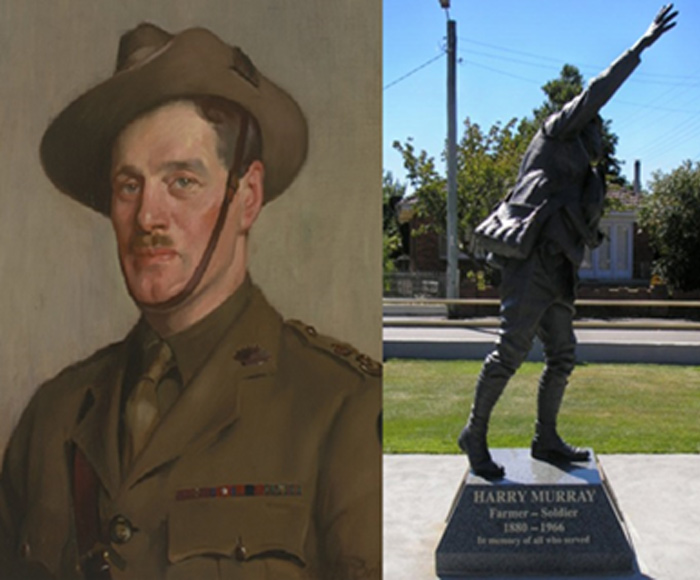
L. Australian War Memorial portrait of Harry Murray VC by George Bell in 1919, & R. Evandale’s Harry Murray VC statue sculpted by Peter Corlet – unveiled 24 Feb 2006
However, just a few hundred metres away in the other direction along Evandale’s Murray Street there was another quieter ceremony earlier in the day (24 February 2006) attended by a number of Murray descendants who were also in Evandale for the Harry Murray statue unveiling. This took place in the original Anglican cemetery on the very spot of the first Murray family vault where KM Sr and KM’s first wife Sarah were also buried. [As will explain later, KM and his second wife Hannah were buried in the ‘other family vault’ which still exists in the Scottish Presbyterian (now Uniting Church) cemetery literally across the road]. Organised by family historians Joseph Cocker and Terry Browne, this was the ‘unveiling’ rather of a plaque remembering as ‘early pioneers of Australia’ the Kennedy Murray father and son who both died in Evandale some years before Harry was born there in 1880.
The focus on Kennedy Murray Jr in Karl Von Stieglitz’s ‘Evandale histories’ ?
There are several related ironies involved in how this very spot was remembered and located for the family by the former Australian Army Colonel David Von Stieglitz – who was not only the then president of the Evandale History Society but also the chairman of the Harry Murray VC Memorial committee as well. As Terry Browne has recalled in an article shared with the family, David had good reason to remember the exact site of the Murray family crypt just opposite the Von Stieglitz family crypt in the St. Andrews Anglican Church cemetery. Apparently, in 1948 it was he who had ‘knocked down’ the Murray family vault after the cemetery became part of Pioneer Park. This was because it was considered ‘dangerous’ according to Von Stieglitz. The destruction of this Murray family grave took place about two years after the publication of David’s father Karl Von Stieglitz’s first local historical account of the founding of Evandale which makes a single brief and inaccurate mention of Murray – for having ‘donated’ some of the land for the building of the new Anglican Church in the 1840s. And in the lead up to the statue unveiling in 2006, the Society commissioned a booklet about Harry (The story of Lieutenant-Colonel Henry William Murray VC) by the same researcher M.J. Maddock. With the aid of Joseph Cocker Maddock had in c1992 compiled a related booklet profile of the father and son Kennedy Murrays and their descendants (Kennedy Murray the first one hundred years or so… From 1782 in New South Wales).
Karl Von Stieglitz later wrote a more developed account The History of Evandale published in 1967. Although this work made further mention of Kennedy Murray as one of a number of significant ‘early Evandale personalities’, it did not discuss or explore in any significant detail his possible further role in the development of ‘old Evandale’. However, the book does briefly (and inaccurately) focus on how Evandale was only gazetted and formally named in 1848. This was when the town was already quite developed and after the irregularity of its actual origins had come to light (i.e. as a village built entirely on ‘surrounding settlers’ land grants’ whilst government provisions only applied to a ‘non-existent’ town Morven planned several kilometres away). Thus, in addition to also reflecting Von Stieglitz’s main interests across about forty Tasmanian local history ‘works’ (about pioneering farming families and the Anglican Church, etc), this particular work generally takes the 1848 ‘retrospective gazetting’ of Evandale as its starting point (suggesting that the actual story about the founding and earlier development of the town had largely been lost or forgotten).
An excerpt from the ANU’s bio for Karl Von Stieglitz https://adb.anu.edu.au/biography/von-stieglitz-karl-rawdon-13229: “Von Stieglitz was best known for his contributions to local history, inspired by an enthusiasm for his pioneer pastoral ancestors, a visit to Britain in 1906-07 and his belief in the primacy of the landowning class. His thirty-eight works, which covered pastoral history, bushrangers and churches, could best be described as a pageant of pioneer families. The books lacked a chronological or thematic framework, included unverified stories and had a concept of pastoralists as the motive force for change. He had a roseate view of convict assignees as old lags, and regarded Aborigines as simple and inoffensive until roused to revenge. His charm and pastoral background, however, gave him access to oral reminiscences and previously unused family material such as letters, manuscripts and photographs. In epilogues and interludes he showed a poetic streak and an Arcadian appreciation of the environment”.
John and Mary Von Stieglitz arrived in Evandale in the late 1880s – when there were few or none around it seems who could remember much about ‘old Evandale’ or its founding. This was when John and wife Mary came and purchased the Andora property – on which their son Karl later established a Corriedale sheep stud. Following his 1946 publication Days and Ways in Old Evandale (a ‘compilation of sketches’) Von Stieglitz’s later 1967 History of Evandale continues the earlier selective and general ‘post-1848’ focus on both known pastoralist personalities and the role of the Anglican Church in the Evandale area. So, as much as these two publications include significant information and valued as well as fascinating related stories, they both reinforce how there are clearly significant ‘gaps’ in the early history of Evandale.
Related gaps in the contemporary record?
As we aim to show in the following sections, we think the Murray family history can assist with addressing these gaps towards a fuller picture about the story of what is today acknowledged by many (especially by Tasmanian tourist offices) as “as one of the best preserved historic Australian towns… classified by the National Trust as a Georgian village” [e.g. https://greataustraliansecret.com/tasmania/north-east-tasmania/evandale]. And not just the ’gaps’ but also the demonstrable inaccuracies of what might be called a ‘rear-view mirror’ approach to people and to dates and events from the past seen in isolation against a seemingly inevitable ‘foggy’ background. This is an approach which typically includes confusions as well as omissions about the names by which local places and emergent particular communities were generally known in times past [As this book will describe around the pivotal story of Kennedy Murray, we think that a ‘family history perspective’ can help rather with an alternative focus on the building of communities in time and place in terms of the importance of connections and relationships. Such a perspective is important to the foundational stories of not just Evandale but also Norfolk Plains and Port Dalrymple (i.e. the emerging Launceston and districts)].
For instance, just as one of a number of demonstrable inaccuracies of the Wikipedia entry for Evandale is the following: “The town of Evandale was progressively built on land previously belonging to Collins and Barclay from the 1820s” (i.e. there is no mention of how in those early stages especially, that the emerging village was almost entirely built rather on Kennedy Murray’s 1820 land grant as well as in terms of his central role in the early building program). And a 9 July 2016 Launceston Mercury article “Evandale visit a step back in time” exemplifies the widespread gross inaccuracies about the historic origins of Evandale: “Originally established as a military post in 1811 [no it was not – that was a temporary camp which was situated across the ‘other side’ of the South Esk], the township was known variously as Collins Hill, Paterson’s Plains, Gordon Plains and Morven before the name was changed to Evansdale [all of this demonstrably or generally false] and finally to Evandale in 1836, in honour of Tasmania’s first Surveyor-General, G.W. Evans” [and even the partial and controversial ‘truths’ of the last two claims was only in retrospect].
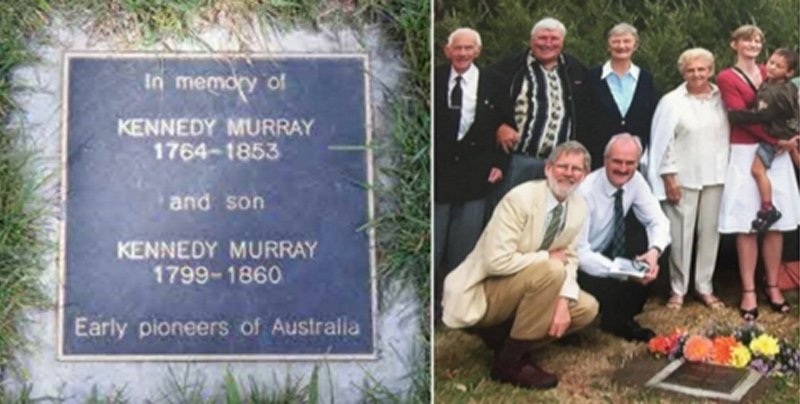
L. the 2006 Murray family memorial plaque. R. the 24 Feb 2006 Kennedy Murray family history memorial event just up the road from the Harry Murray VC statue unveiling (main organisers Joseph Murray Cocker and Terry Browne are top left)
And, so, the pivotal role of the Kennedy Murrays became generally ‘lost’ to the emergent local history of the place – but remained engrained in the Murray family history even if descendants did become dispersed and forgetful. And so, long before the 2006 renewal of interest a number of ‘family historians’ made useful linked contributions to remembering both the family tree and researching the verifiable details of the family history with its particular inevitable connections to the story of Evandale. In this way, not just Joseph Cocker and Terry Browne but also others such as Harry Hunt and Reg Murray have helped resurrect the significance of Kennedy Murray Jr as a pioneer of North-East Tasmania (and in Evandale specifically). They have helped remember how he and his father (Kennedy Murray Sr) together represented related exemplary stories of early Australian colonial history (as summarised also in the appendix as well as to be detailed further in a planned ‘companion work’ focused rather on Murray Sr).