
Norfolk Island
Kennedy Murray’s 1799 birth and early childhood on Norfolk Island
Kennedy Murray was born on the South Seas island (first settlement) paradise of Norfolk in 1799. He was literally raised as a reasonably carefree child able to wander on the idyllic South Pacific ocean beaches of Kingston. He was also brought up as part of a supportive close-knit community which included the Kingston school mainly established by his later ‘step father-in-law’ Thomas McQueen. He was the first of two children to his parents Kennedy Murray Senior (KM Sr) and Ann White. After having literally been born in an Ayrshire Scotland castle to a ‘good family’ (see Part 2), KM Sr had arrived in the Port Jackson settlement as a convict on the Pitt on 14/8/1792 as part of the Fourth Fleet to the Australian colony – and in the first group of Scotsmen to land in Australia. Here he spent some years working at Toongabbie a government farm as well as convict station chosen by the first Governor Phillip to grow food for the colony.
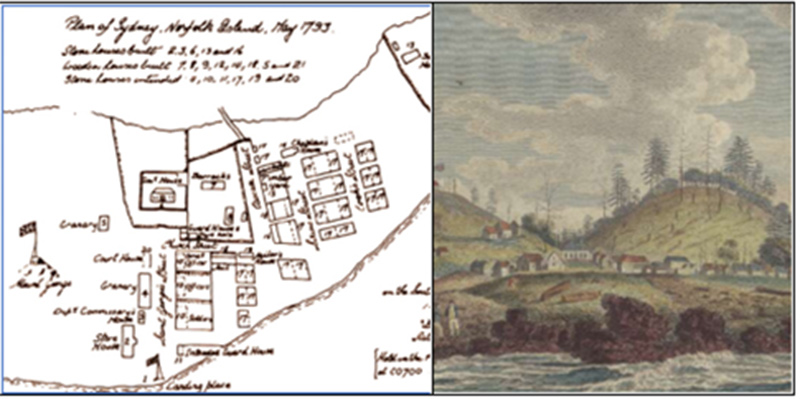
L. Charles Grimes 1793 ‘Plan of Sydney, Norfolk Island’. R. Wilson Lowry’s 1798 painting ‘View of Sydney on the South Side of Norfolk Island’
Murray was later transferred to Norfolk Island which Phillip had also directed his HMS Sirius second lieutenant King to settle in March 1788 – just five weeks after the First Fleet arrived in Sydney. This was the earlier fallback plan of an alternative food source if need be to what turned out to be the ‘less fertile’ Sydney Cove settlement (following the initial disappointment also of Botany Bay). Murray arrived there on Norfolk Island 19 Jan 1796, to finish his fourteen-year 1780s sentence of transportation to the colony for a petty crime committed in Glasgow as a fourteen-year-old.
It seems that sometime between 1796 and 1798 KM Sr and Ann White Scott linked up romantically as well as likely in some work-related relationship. This was almost certainly to do with the Arthur’ Vale ‘common gardens’ close by to the Sydney settlement where both appear to have lived for the rest of their time on Norfolk Island (KM Sr departing in 1804 with the Brig Harrington and Ann in 1813 on the Lady Nelson). Before King left in 1796 the Sydney settlement (which he often referred to as ‘rooty hill’ – a name he later also adopted to a part of the ‘other Sydney’) had developed into an effective ‘farming town’ rather than any mere penal settlement (re-named Kingston) with a courthouse, jail, school, Church and hospital in the central area. As indicated on the map, several streets were built that divided the various different residential sections built of either stone or wooden houses (officers, main barracks, ‘convict’ workers, etc).
To the West were the Arthur’s Vale gardens (i.e. the main part of ’the ground cultivated for the Crown’) established along a creek that downstream poured into a swampland behind the initial settlement. It was along ‘Watermill Creek’ that Nathaniel Lucas built an early dam and mill – and was rewarded for his efforts by being awarded a first and later a second farming lot allocation. The swampland area was drained in 1795 and a canal was built through this. The canal proceeded to the Chimney Hill area to the East where a lime burning operation had been set up c1791. As well as being near the 1796 ‘burying ground’, this was adjacent to the idyllic Emily Bay beach away from the dangerous front main beach (and main ‘landing place’) behind the coral reefs that had sunk the First Fleet flagship the HMS Sirius in 1790. Just as the school catered for a growing group of the children in the settlement, so no doubt these young children (some of the first native-born children in Australia – later including Kennedy Murray and George Collins) would have often descended to these beaches to meet and play.
Ann White had also come to the Port Jackson colony as a convict herself – together with her childhood best friend Sarah Woolley. Both were 15-year-olds when convicted in 1789 at the Old Bailey of the same minor indiscretion involving a ‘a couple of extra yards of cotton’ beyond the one and half yards Sarah had paid for. Both White and Woolley arrived in Sydney on 28 June 1790, on the infamous Neptune as part of the earlier Second Fleet [3]. Ann White was assigned to go to Norfolk Island in late 1791 (where she also rejoined Woolley) [4]. She had already started a relationship with (and had a child with who died within her first year) a John Scott. Scott was a seaman who had assisted on the First Fleet flagship the HMS Sirius until it was shipwrecked at Norfolk Island in March 1790 (after which he returned to Port Jackson and joined HMS Supply). He resigned his commission to accompany Ann to Kingston on Norfolk Island when she arrived there on 11 Nov. 1791. Here we now know for sure that Scott and Ann were married that month by the visiting NSW colony chaplain Rev. Richard Johnson [5]. First Commandant Philip Gidley King initially partnered and had two children with one of the local convict women Anne Inett. Their first-born son was named Norfolk King (the first native-born Australian in the Royal Navy) and their second Sydney King. Philip Gidley King was keen to not just support the convict ‘government servants’ generally, but to get the men to marry and support the women to also relieve pressure on the Commissariat (or government stores office). Like others then, Scott soon got a land grant to the immediate East of Kingston shown on the map.
In late 1795 John Scott left on a ship sailing to China (and apparently never ‘returned’). Ann continued to live on the island until she left 22 years later in 1813 in the last group from the closed-down settlement. This was most likely related to how we know that many of the early free settlers (usually former sailors or soldiers) on Norfolk Island like Scott had left before 1796 as many of the ‘small farms’ on the hilly island were in areas too difficult to cultivate crops – yet also too challenging to fence and otherwise run sheep or cattle. There could have been a connection to an incident in 1794 which saw Scott fined by the authorities “for assaulting a soldier who was on Scott’s ground enticing his wife from him” (p.137 of the 1794 NSW Historical Records Vol. 2). We have seen mention of a John Scott in a later Sydney Muster record. So perhaps this particular Scott did ‘return’ – just not to Norfolk Island or to Ann.
It is not generally known that before the 1820s (i.e. before the later fearful penitentiary model that was also applied to the second later settlement of Norfolk Island after 1825) most early ‘convicts’ in Australia were not usually kept in jails per se – unless as ‘secondary punishment’ for further misdemeanors. They were typically either assigned by the Government for public works (such as government farms or road-gangs) or alternatively could be assigned to private individuals as a form of indentured labor also available to the early free settlers (including emancipists who had previously been convicts themselves). And they could (depending on their luck) be assigned to either harsh or sympathetic ‘supervisors’ who might support or not their workers or even ‘spouses’ after emancipation. This practice was also earlier common in the NSW colony (backed up by ‘the lash’), but later still in place in revised form in Van Dieman’s Land right up until the end of convict transportation in 1853. The only actual large-scale ‘jails’ until much later on (e.g. Newcastle in NSW and Macquarie Bay later replaced by Port Arthur in Van Dieman’s Land and the ‘hell on earth’ Norfolk Island second settlement) were for the worst ‘recalcitrant’ convicts.
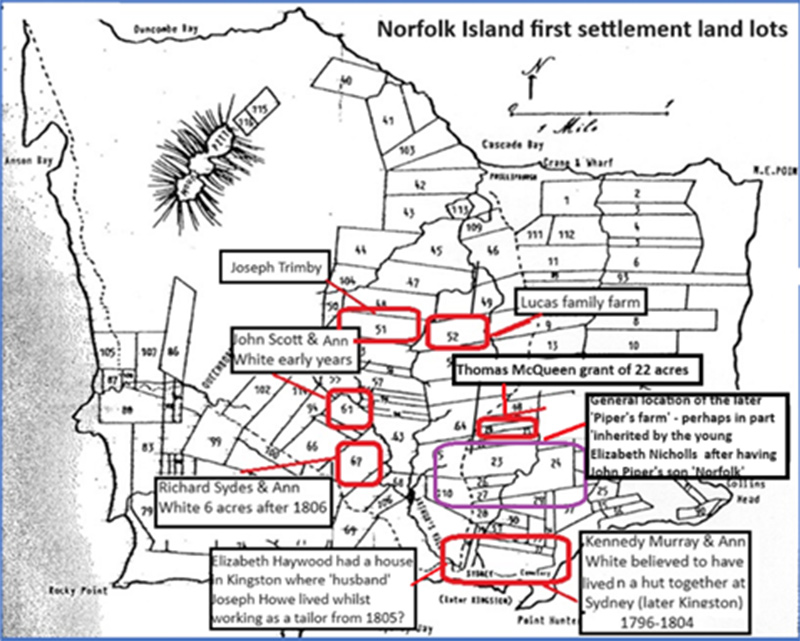
Later ‘cadastral map’ of the 1796 Norfolk Island 1stt settlement land lots ‘re-allocation’ – adapting the earlier ‘realistic 1794 Grimes map’ (plus Chapman and Bradley versions)
In this way, Murray Sr may have become assigned to assist (or otherwise work with) Ann White in the running of a garden farm at Arthur’s Vale (nearby to the Kingston settlement – see map above) soon after he arrived on the island in late 1796. In any case, this recognised ‘common law’ union also ultimately produced a son Kennedy Murray on 4 Aug 1799, and a daughter Elizabeth Murray on 20 March 1802. Both children were baptised by the visiting Anglican Reverend Fulton on 18 April 1802 – a few months after KM Sr received his Certificate of Emancipation on January 1 that year.
As we discuss further in chapter 13, Murray Sr sailed for Sydney Cove on the Brig Harrington in January 1804 it seems. We know that he went there to seek a land grant on the mainland from Governor King (the same earlier commandant of Norfolk Island) in order to later transfer his family – with it already being known by then that the government was considering closing down the first Norfolk Island settlement. By the time Kennedy had been approved to become part of the initial small group of free settlers who sailed to the original Derwent first settlement of Van Dieman’s land in April 1805, Ann had not only started a new relationship with Richard Sydes (a convict blacksmith working in that capacity on the island) – but had already had a daughter Mary with him born on 30 Oct 1804. As Murray Sr had been granted permission at the start of 1805 after many months of effort to take his family to the new settlement, it is reasonable to assume that he was not aware of Ann’s new relationship – and how (especially after her experience with John Scott ‘not returning’) Ann apparently got impatient waiting.
And so it was that Kennedy Murray and his sister Elizabeth spent the formative part of their childhood growing up in the then as now relatively idyllic South Pacific paradise Norfolk Island – and specifically in Kingson where the children could play on the nearby beaches there. They did so as part of an extended family that included four other younger half-siblings from the union of their mother and Richard Sydes. Sydes had received an Island land grant of 6 acres (part of Lot 67) on which he and Ann were known to be farming between 1806 and 1812. Except for a small final ‘cleaning up’ party tasked with destroying all the established buildings on the island, they were part of the last remaining group of around 145 Norfolk Islanders that reluctantly agreed to be ‘re-settled’ (on top of dozens who stayed to clean up and then head rather to Sydney). This group arrived in Port Dalrymple on the ships Minstrel and Lady Nelson (the Sydes family arriving on the Lady Nelson) which both arrived in early March 1813) [6].
Some years earlier (between 1807 and 1808) around 550 Norfolk Islanders had voluntarily left the island because of imminent plans to close the settlement – with around 160 of that earlier group initially re-settled by the colonial government on small farms at ‘New Norfolk’ (in 1811 Macquarie founding and naming Elizabeth Town before this reverted to New Norfolk in 1825) just 30 klm or so North of the then Hobart Town settlement. The last group, however, had been clearly reluctant to leave their island paradise until they were effectively forced out by UK government instructions to incoming Governor Macquarie to urgently close this costly settlement. In those additional five years, they had perhaps become an even more close-knit group than the New Norfolk group (one which generally remained together after re-settlement) – but also with a demonstrably larger percentage of older native-born colonial children (like Kennedy Murray) as well as emancipist settlers.
The plaque below includes the names of those Norfolk Islanders on the second ship the Lady Nelson also about to become the founding farmers of Norfolk Plains (Elizabeth Haywood Lowe’s first daughter Elizeth Nichols was on the other boat the Minstrel). One of the Cox children on the boat Samuel would later marry another Lucas daughter (Mary Ann) and become a prominent farmer in the area in its transition to the town and district of Longford. And the Trimby father Joseph and son James would late be convicted of stealing sheep from David Gibson’s flock – and be sentenced to a long stint at Newcastle jail (never to return to VDL).
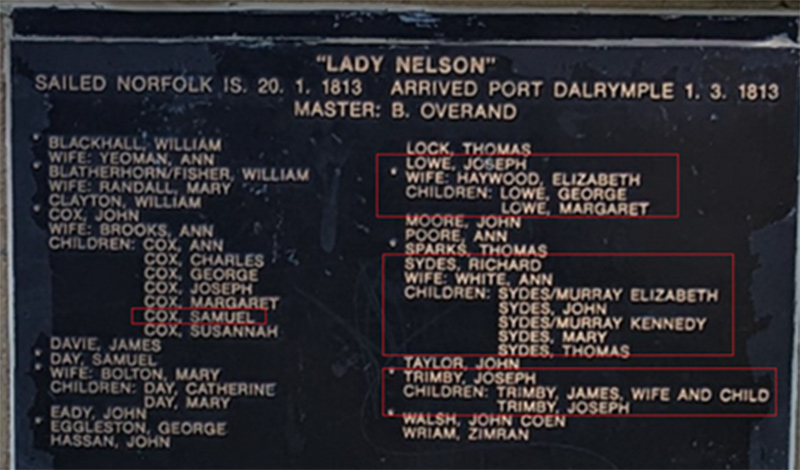
Photo of the 1813 Lady Nelson section of the Hobart Memorial Plaque (in St. David’s Park) to Norfolk Islanders who were ‘evacuated’ to Van Dieman’s Land – unveiled 29 Dec 1992
But most notably for present purposes, there were also the Lowe and Sydes families that included the similarly aged young George Collins (Lowe on the plaque) and Kennedy Murray (likewise Sydes on the plaque) respectively. Joseph Lowe and Richard Sydes were both originally from the same town in England (Warwick) and after years as neighbours on Norfolk Island were also very close friends as were their partners Elizabeth Haywood and Ann White – who had both been neighbours at Kingston from 1791 when both got married to their first partners on the same day in November that year (along with Nathaniel and Olivia Lucas). Both couples (and their extended families) not only became nearby neighbours also on farms at Norfolk Plains in VDL (just a few lots separating their small farms and farmhouses there) – but also got married the same day and place (in the Launceston Anglican church, March 1814) in similar fashion to how Elizabeth and Ann had both got married to their first partners in November 1791 on the same day in Kingston (i.e. exactly 23 years later to the hour).
And so, in the subsequent years of the early Norfolk Plains settlement there were many marriages within the group. Many of the older couples were able to marry after not having that option on the island in earlier years (e.g. Richard Sydes and Ann White Scott in March 1814 – coincidently the very same day that Kennedy Murray Sr married his new partner Ann Parker in Sydney). And then there was the younger ‘next generation’ group of children ‘born free’ on Norfolk Island. This second group in the closeknit Norfolk Islander community at Port Dalrymple included not just Kennedy and Elizabeth, but their Sydes half-siblings as well who all ended up following Kennedy and Elizabeth (and their spouses) to Evandale some years later.
- Norfolk Island was also settled in 1788 – On March 6th just six weeks after the First Fleet landed in Sydney. This in turn was after Captain James Cook some years earlier (when discovering the Island) had spotted an abundance of local flax there as well as the Norfolk Pines trees which might additionally serve as a potential source of ships’ masks. However, the economic potential was not sustained, and the problem of a reliable and safe landing place was never resolved despite several attempts. When the Island became expensive to maintain London was keen to close the first Norfolk Island settlement down. So, when it was re-opened as a penitentiary in 1825 it had been re-designed rather as a convict hell rather than as the effective pacific island paradise it had been for those convicts sent to the first settlement (perhaps excepting the 1800-1804 stint of commandant Major Foveaux). This was obviously a key reason why the last group of settlers were so reluctant to leave.
- There had been big inducements to this earlier group that the later 1813 Norfolk Plain-ers had wisely ignored – promises which the British government made failing to consult the ‘preoccupied’ David Collins (the first Lieutenant-Governor of the struggling Van Dieman’s Land settlement). Norfolk Islander settlers who agreed to make the earlier move to the mainland were promised to get two acres for every cleared one they owned on the Island (etc). Buildings were to be provided free of charge and equal in value to those left behind. They were also “to be clothed and provided with rations for two years and to be given the labour of four convicts for the first nine months in Van Diemen’s Land and two for a further fifteen months” [Von Stieglitz (1947), The History of Longford]. The often-unfair inconsistency in the awarding of land grants and the backing up of these promises led to much disappointment in this group (on top of the unforeseen challenges of farming in this area). Six months after his 1811 visit (including a visit to Elizabeth Town before heading for Port Dalrymple), Macquarie had got a surveyor to map out the small farms to be granted to the 1813 settlers to provide greater assurance as well as inducement to them to go along with the compulsory move.
- Sarah Woolley married a John Ryan the same day on Norfolk Island (Nov. 1791) that Ann White married John Scott. After Ryan returned to Sydney to get a land grant Woolley and a child Elixabeth joined him in early 1895. They received grants of 60 acres at Windsor which they farmed on whilst producing three more children. After Ryan died (by 1800) Woolley continued the farm – getting another 100 acres in her own right on 1804 [see map in chapter 13]. She then married a William Mason having two more children. When the by-now well-known figure in the district died after a buggy accident on 12 Aug.1809. The Sydney Gazette recorded that ‘the funeral was numerously and respectfully attended, many persons travelled ten to twenty miles to pay the last tribute of respect to a departed much-lamented friend whose kindness of disposition and obliging manners have ever been the admiration of all who were acquainted with her…”.
- The Neptune was one of the later three ships of the Second Fleet (the only one with female convicts). It had the highest mortality of this so-called ‘Death Fleet’. The conditions on board are known to have been harshly cruel and dangerous. Unhealthy and inadequate rations lead to a large scurvy outbreak that killed 46 before the boat arrived at Capetown (mid-way on the voyage) and had to delay there. Of the 502 convicts on board 161 (150 men and 11 women) died with many others ill and in poor condition before arrival in Port Jackson. It had been chartered by the slave traders Camden, Calvert & King. Lieutenant John MacArthur (the later famous Australian wool industry pioneer) and his wife Elizabeth had been on board the initial part of the voyage but transferred to the Scarborough after getting into conflict also with the replacement master of the ship.
- The records for November 1991 weddings at Norfolk Island were ‘lost’ but have now been reconstructed from other supporting records. There were reportedly 63 marriages on Norfolk Island in 1791 that were part of the ‘lost records’ of marriage conducted on the island that month. Whilst writing this chapter, I was able to confirm with researcher Cathy Dunn additional evidence of other documents confirming that the visiting Reverend Johnson did officiate the marriage of John Scott and Ann White in 1791 (personal email with attached relevant document 3 Dec 2023). [See also Cathy’s publication Romance among the pine trees – Marriages November 1791 Norfolk Island].
- The Lady Nelson captained by a ‘B. Overand’ left Norfolk Island on 20 Jan 1813, and arrived at Port Dalrymple on 1 March 1813. It included another ‘first fleeter’ as well as George Collins’ mother Elizabeth Haywood (soon to marry her partner Joseph Lowe). This was Josephy Trimby Sr whose story has been recounted at http://www.fellowshipfirstfleeters.org.au/joseph_elliotttrimby.htm). Elizabeth Haywood’s other daughter Elizabeth Nicholls (along with her child Norfolk Piper) was on the second ship Minstrel which arrived on 4 March. The Lady Nelson had a unique historical role in the early settlement of Van Dieman’s Land after being launched in England and arriving in Sydney in 1800. She was one of two ships that assisted with the first settlement of VDL at Risden Cove in 1803. The following year this ship took Paterson to the initial Port Dalrymple settlement. And, also in 1804, it took the founding VDL Lieutenant Governor David Collins from Port Philip to the Derwent where he started the new ‘second colony’ there instead of in the future Victoria. Later still it had assisted with the first transferals of more than 500 Norfolk Islanders to VDL in 1807/8 (many of whom ended up at ‘New Norfolk’ to the North of Hobart).
- See The World News article 6 June 1934, “The Brig Harrington adventures of William Campbell’ at https://trove.nla.gov.au/newspaper/article/136998232. The future Harrington Park of Sydney was named for his brig after Campbell received a 2000 acres grant there by Macquarie. This was part of his awarded compensation after the Brig Harrington was seized by convicts in 1808 and sailed to the Philippines – where it was set alight and sunk by the convicts in early 1809 after they had been found and confronted by the HMS Dedaigneuse.