
Norfolk Plains (Tas)
The 1813 move to Tasmania’s Norfolk Plains from Norfolk Island
The slow but persistent deportation of the Norfolk Islanders to the South between 1806 and 1814 should be much better known and appreciated, as should the deep emotional connections their descendants maintain with their ancestral island. Stimulated by the World Heritage listing 2010 and the approaching bicentenary of the 2013 deportations, the lost world of the Norfolk Plains is awaiting rediscovery.
– Bruce Baskerville (2011), ‘Bound for the Norfolk Plains’, HistoryMatrix
Like most of the other re-settled Norfolk Islanders eligible (most of whom received similarly sized small farm grants), Richard Sydes was in 1813 granted 50 acres of land (Parcel 33) along the South Esk to the immediate North-East of present-day Longford. This was one of the original 50 farms of the Norfolk Plains re-settlement [1]. The original pre-1813 survey of these 50 farms was organised by Macquarie to entice the last remaining Norfolk Island group. It appears to have been prepared by G.W. Evans who definitely was responsible for the related C1 1814 map that was signed off by Macquarie on 30 April 1814 [AF396-1-1325]. Evans also produced the map of the 1818/1819 general survey of ‘Port Dalrymple farmlands’ which can be accessed at the following Trove link https://nla.gov.au/nla.obj-231304508/view.
Because of the continuing food shortages in Sydney Town at that stage, the general expectation of this group was that they should grow wheat and other food crops (maize, barley, rye and oats as well as potatoes, etc). This might be supplanted by some stock – perhaps a few pigs or even cows as well as horses. But from the start these farms were too small to support an alternative pastoral focus on sheep flocks as well as cattle herds of later and much more successful incoming free settlers such as Thomas Archer (following in the footsteps of John MacArthur and others in NSW). Archer (like his friend James Cox a few years later) had access to political as well as financial resources that the Norfolk Islanders generally did not to build his Woolmer’s farm (e.g. with cheap assigned mass convict labour as well as his initial 1700 acres grant from Macquarie in 1817). To make matters worse, the early promise of the small farms to produce wheat and related crops was soon largely dashed by smaller yearly returns from both their land and markets to NSW (which had also been initially promising before the growing competition in Sydney Town after the NSW settlements were opened up beyond the Blue Mountains and elsewhere).
As Bruce Baskerville has appropriately commented about the older emancipists in the Norfolk Islander contingent of the initial Norfolk Plains re-settlement: “Despite their weariness and resentment they tried to conform to expectations, following instructions to grow wheat on the Norfolk Plains then seeing their hard work dissipate before their eyes as plant diseases and soil exhaustion wreaked a slow catastrophe. Some fell victim to melancholy and nostalgia as they saw friends and family succumb to alcoholism, carelessly accidental deaths, decaying farms, lassitude and crime while around them newer emigrants rode the Empire’s rising demand for wool and the beginning of a wool boom that would last for decades” [2].
All this is background to how it was that many of this group eventually followed Kennedy Murray and his extended family to Evandale as this Murray village (unlike the Norfolk Plains community centred around that later emerging Longford) grew into a sizeable town [3]. But Baskerville’s conclusions do not accurately do justice to either the enterprising efforts of many of this group (in the early years at least), or how a number of the children of the initial settlers (like Kennedy Murray and George Collins) were able to recognise and exploit out two key ideas. One was that pastoralism (not just ‘crop-growing’) was the key to future ‘thriving and not just surviving’ in early rural Australia. Second, it was also important to seek and get the right support for further land grant applications that could support sheep herds in similar fashion to Thomas Archer, Captain Barclay, and (as we will see below) Kennedy Murray’s early mentor James Cox of Clarendon. Thomas Archer’s brother William also came that year and from family and related support was able to buy out some of the first struggling Norfolk Plains farmers from Norfolk Island to form the large and later very successful Brickendon (still operated by Archer descendants today).
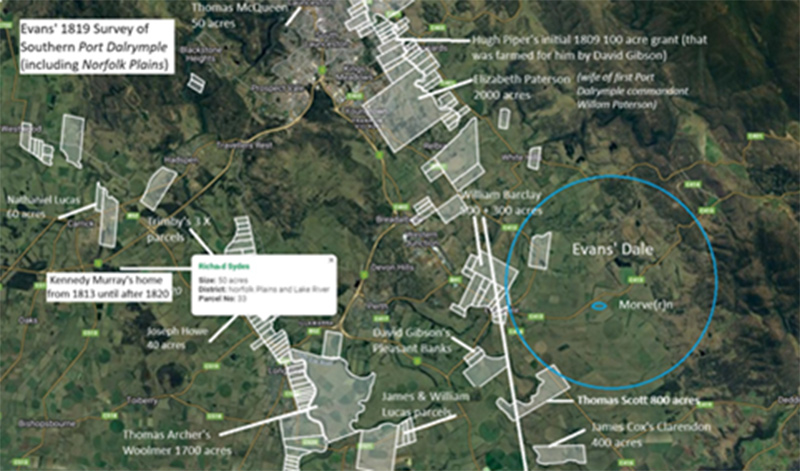
An adaption of the digital version of the 1818/1819 Evans map of Port Dalrymple settler grants by Cartigas, ANU http://peopleaustralia.anu.edu.au/entity/12452
So, whilst Baskerville’s comments may apply to some of the older emancipist settlers given smaller grants in 1813, as exemplified by the lives at Evandale of Kennedy Murray, his brother-in-law George Collins and other extended family and friends, we do not think they generally apply to the ‘native-born children of the Norfolk Island-cum-Plains Settlers’. It could be argued that, perhaps more than other comparable example at the time, this particular group of ‘close-knit native-born children were really the exemplary ‘blueprint’ of the democratic vision of a future Australia held by Macquarie and others – marrying the idyllic ‘lost Pacific Ocean paradise’ of Norfolk Island into the new economic opportunities for settlement. The fair-minded and visionary Macquarie saw before anyone else that such a model could and should come from the emancipists and native-born Australians and not just the emerging often ‘privileged and elitist’ networks of the NSW Corps and their settler friends.
Two of Kennedy’s other brothers-in-law (James and Thomas who married sister Elizabeth and half-sibling Margaret) were from the similarly energetic and enterprising Lucas family – that along with the story of Kennedy Murray (and also that of his brother-in-law George Collins and Collin’s other brother-in-law David Gibson) exemplified the early promise of Norfolk Plains that would eventually be better realised in the adjoining Evandale district. Father of the clan Nathaniel had moved to the mainland Sydney from Norfolk Island after his appointment by the new Governor King (the earlier commandant of the Norfolk Island settlement who had relied so much on Lucas from the start) as Master Builder of Sydney. As well as later building the 1816 Mint in Macquarie Street, Lucas had earlier built the first windmill at Sydney Cove. After his initial appointment he was also appointed the emancipist Superintendent of Carpenters in Sydney from 1808 and, as well, received a sizeable land grant for a farm at Liverpool (which remained the Sydney base for the family over subsequent decades). Nathaniel later worked closely with another ex-convict the architect and stonemason Francis Greenway on St Lukes Church Liverpool – one of the many buildings which were part of the now much valued Macquarie building program in the early colonial settlement.
In 1817 two of the older Lucas brothers William and Nathaniel Jr came to Port Dalrymple to build the first Windmill in Van Dieman’s Land (as their father Nathaniel Lucas Sr had done in Sydney). This was on the spot of the still-named Windmill Hill of Launceston which is adjacent to the site of the original 1807 Government Cottage of the early Port Dalrymple settlement. They obviously reconnected at this time with other former Norfolk Islanders. In September 1818 they joined their mother Olivia and four other siblings in making the move to Port Dalrymple, whilst elder brother John remained to run the family farm and also mill there. This was just a few months after her husband Nathaniel Sr’s tragic death following an argument with Greenway and also an apparent illness which may have caused both events. We think that (along with the new economic opportunities attracting the Lucas brothers) the chance to re-join two of her oldest friends from Norfolk Island (Ann White Sydes and Elizabeth Haywood Howe living as ‘next-door neighbours’ again at Norfolk Plains) was perhaps a key factor in also Olivia’s decision to make a permanent move there with most of the family. After this, four of the brothers took on land grants (see above) or acquired additional lands in the Norfolk Plains or adjacent areas. Guided by William (also a boat-builder earlier on as well as a carpenter trained by his father as most of his brothers were) and partly financed by John in Sydney, James and Charles Lucas (with the assistance of brother-in-law Charles Williams) later built the family’s own boat The Olivia to transport and (with John’s direct assistance also) sell their Norfolk Plains produce in the lucrative market of Sydney [4].
Kennedy Murray was one of the ‘extended Lucas family’ who would have attended the June 1830 funeral in Launceston of ‘Lucas family matriarch’ Olivia Gascoigne Lucas [5]. The Launceston Examiner (14 June, 1830) reported that “She was attended to the grave by a numerous assembly, a great part of whom were related to her, by descent or marriage, amongst whom were 5 of her sons and 4 daughters, with their respective husbands and wives, and their relatives on both sides, and also numerous grand-children [i.e. many of her known 115 grandchildren – see later discussion]. It was a faint resemblance of the Patriarchs of old”. Ann White Sydes had died years earlier in 1820. If she had lived as long as Kennedy Murray Sr (who died in Evandale in 1852 surrounded by a large extended family) then such comments would likely applied to her as well with her large number of known grandchildren; and likewise, to Elizabeth Haywood Lowe, Olivia and Ann’s old friend from the Island (and early Colony convict days) who also united with them at Norfolk Plains.
Elizabeth Haywood Lowe died at Launceston in November 1836, surrounded also by dozens of grandchildren produced by son George Collins as well as Elizabeth Nicholls Gibson and Margaret Nicholls Hayes (whose daughter married Henry, son of John Glover, and therefore whose granddaughter married Ann White’s grandson William, son of Kennedy Murray). Elizabeth Haywood Lowe’s last husband Joseph did also prosper reasonably well alongside his successful stepchildren. [Sometimes in partnership with them (including George Collins at the future Evandale), he also accumulated further lands for pastoral activities]. He made it to the age of 82 before his death notice in the Launceston Examiner (13 Sept 1853) acknowledged that “he was one of the first inhabitants in the colony, and perhaps the oldest resident in Launceston”. In any case, it would surely not be inaccurate to say the re-connection of Ann, Elizabeth and Oliva (the re-united ‘Matriarchs’ of their inter-linked families) at Norfolk Plains was a key foundation for the subsequent emergence of Evandale as also a ‘Norfolk Plains overflow’.
Kennedy’s sister Elizabeth had married James Lucas on the same day (18th January 1819) that he (Kennedy) had married another Norfolk Islander Sarah McQueen in Launceston’s St. Johns Church. On 18 Jan 1819, Kennedy Murray married Sarah (born 15 July 1805 on Norfolk Island) at St. Johns Church in Launceston and their first-born child Sarah was born towards the end of that year. Sarah was the stepdaughter of Thomas McQueen the former convict schoolmaster at Norfolk Island. McQueen had originally arrived on Norfolk Island in November 1791 on the same ship as Ann White it seems. Over time on the Island (and later in Sydney as well as in Port Dalrymple after 1810, Murray’s father-in-law McQueen had developed a general reputation of the most proficient teacher in the colony [6]. McQueen possibly taught a young Kennedy Murray there. In any case his guidance also at Port Dalrymple (and that of Murray’s literate as well as caring stepfather Richard Sydes) may help explain how Kennedy Murray became literate enough through ‘self-learning’ to write his own land grant applications well before he took on the District Constable position – which clearly required such skills [7].
Another sister Margaret some years later married James’ younger brother Thomas. This was before they also (like James and Elizabeth and their large family) moved to live at the future Evansdale circa 1830 to join not just Kennedy and Sarah but also older sister Ann-Mary and husband George Collins. Collins (son of Elizabeth Haywood Howe and brother of Elizabeth Nicholls) was another Norfolk Islander who received a large grant adjacent to his close lifelong friend as well as brother-in-law Kennedy, and also built a neighbouring cottage close by in 1826 to form a ‘joint pivot’ of an emerging extended ‘family and friends’ village at that stage. As exemplified by Kennedy and George’s respective 1831 land grant applications, like other early free settlers with land grants they were obliged by the Colonial Government to use available convicts (or ‘crown servants’) as free available labor to help settle the land. These workers were accommodated in the initial hamlets built by Kennedy Murray and George Collins in the immediate area around their adjoining 1826 houses.
The main difference then between the future Evandale and the superficially similar ‘villages’ that had also emerged at Clarendon, Woolmers and even Barclay’s Cambock was that the latter were rather built for a future emerging community rather than a temporary workforce. The early ‘adjoining hamlets’ of the future Evandale was a shared community involving extended family and friends (as well as the required convict workers). So, from the start Murray especially had a commitment to the future community surrounding him that was clearly lacking in comparable hamlets of mere convict or even emancipist workers on other larger farms at the time.
After several years of struggling on his Norfolk Plains farm like many of his friends, Kennedy Murray’s step-father Richard Sydes secured a position in the Port Dalrymple Government Blacksmiths that was initially located in Launceston and then were moved to George Town in early 1818. This was after Macquarie (who re-named the former Outer Cove at the mouth of the Tamar on his 1811 visit) in 1816 formally made Georgetown rather than ‘marshy’ Launceston the official Centre of the Port Dalrymple settlement [7[1]]. One position was superintendent of the new settlement Government Blacksmiths. And the second position was an inspector of Works. Family records indicate that after his move there in 1818 Sydes soon bought land and built a house on Macquarie Street. Related records further indicate that in early 1816 Kennedy Murray also began working worked with or under his step-father as a blacksmith’s assistant at Launceston and remained there for just under two years.
According to one family historian Reg Murray (1995), Kennedy was relatively well-paid there (being paid just over 42 pounds per annum) and the position clearly allowed him to develop some confidence about his future as well as time to consider whether he wanted to remain a blacksmith like Sydes or pursue some of the new opportunities opening up for pastoral farming in Van Dieman’s Land as well as in NSW at the time. So, by late 1817 when Sydes agreed to move to Georgetown, it seems that at this time Kennedy decided to try and make a go of farming – returning to live full time on the family farm at Norfolk Plains near family and friends.
We know that by the time of his 1818 application (dated 23 April) Kennedy he was also assisting or working for others from the base of the small family farm at the heart of Norfolk Plains. This is most likely how he and also Collins as well as the Lucas brothers came to ‘know’ influential pastoralist James Cox (possibly through Cox’s close friend Thomas Archer at nearby Woolmer’s estate). Although as well as getting his own farming land grant in the future Evansdale district in 1814, Cox also was alternately based in Launceston from 1817 as a wholesale merchant supplying the government commissariat with produce from other peoples farms as well as his own (so he may have met Kennedy Murray when he was also working in Launceston at that time). It was in 1817 that he was first appointed a JP (and thus a recognised ‘magistrate’) by the colonial government. In any case it is clear that (a) their paths crossed significantly and enduringly, and that (b) subsequently Murray was able to get James Cox’s firm support for that April application – and also in terms of a recommendation clearly grounded in some kind of direct knowledge or experience. In other words, however well Cox personally knew Murray at that stage, it would also have been also the additional trusted character testimony of others well known to Cox in the Norfolk Plains community who also knew Kennedy that would have been relevant. This would have given Cox the needed confidence to put his signature to a supportive testimony for a not insignificant or unimportant document (a land grant application) being sent to the Governor of the colony who was also a very experienced and senior Army officer over many years.
It was therefore as a relatively literate nineteen-year old native born colonial (exuding youthful self-confidence already grounded in some substance) that Murray submitted an application to Macquarie on 23 April 1818 with the following direct plea – “This memorialist… most humbly begs your excellency will be pleased to grant him a farm at this settlement together with such other indulgences as a free person born in the colony”. James Cox’s father William was one of Macquarie’s closest and most ‘rewarded’ associates in Sydney (not just commissioned to supervise the building of the road across the Blue Mountains but a key figure assisting Macquarie’s building programs at Windsor and elsewhere in the NSW settlement). His influence no doubt helped ensure James also (like himself at Bathurst and Windsor, etc) received a large grant in the Port Dalrymple when he applied for this in 1814. This was after the English born-and-raised James was inspired by a visit to Thomas Archer when he stayed at Archer’s Woolmers farm as well as visited the local Commissariat offices where Archer also worked for the government.
[1] Although often linked to an area at the mouth of the Tamar River, Port Dalrymple was never a particular town (as some assume) but always a general district extending along the Tamar River and also to the South of this. The general settlement called Port Dalrymple was founded in November 1804 overseen by Colonel William Paterson – a then senior officer of the NSW Corps. Under Paterson this was initially situated at Outer Cove (later re-named Georgetown). However, Paterson soon decided on a move to the Tamar River head 50 klm south and initially named Patersonia before Paterson re-named this Launceston in honor of the Cornwall birthplace of then Governor King. When Macquarie toured through in 1811 he decided to re-locate the main settlement back near Outer Cover (re-named York Cove) at an adjacent site he called Georgetown after King George III. Work began on Georgetown in 1815 with the seat of government in Northern Tasmania formally move there in 1819. There was quiet resistance to the move brought to head by Bigge’s challenge to Macquarie about this (linked to his ‘enquiry into colonial administration’). But nothing really changed until after Macquarie departs in 1822. In 1825 the Van Dieman’s Land Lieutenant Governor George Arthur formally moved the northern headquarters back to Launceston. [see https://launcestonhistory.org.au/history-of-launceston/a-timeline-of-launceston/ ]
- One of the ‘local historian’ promoters of Norfolk Plains 2013 (held to ‘commemorate 200 years since the Norfolk Islanders settled the plains’) was Tasmanian Irene Schaffer who has a useful related website (https://www.tasfamily.net.au/~schafferi/index.php). Another Islander descendant who not only publishes her research related to the Norfolk Island first settlement, but also conducts tours to the Island, is Cathy Dunn. One of Dunn’s books that covers the period of the baptism of Kennedy and Elizabeth Murray by the Rev. Fulton is her 2014 booklet Norfolk Island Rev. Fulton baptism, burials and marriages 1801-1806. Dunn also runs Norfolk Island History Lovers Tours (go to https://www.australianhistoryresearch.info/historian-cathy-dunn/ )
- Bruce Baskerville (2011) “Bound for the Norfolk Plains: A lost world in the South”, Your World, Vol. 1, No.3. [https://www.discovernorfolk.com.au/bound-for-the-norfolk-plains/ for an abridged version at Discover Norfolk ]. See also Reg Wright’s (1986) The Forgotten Generation of Norfolk Island and Van Dieman’s Land, Library of Australian History.
- Before its name was changed to Longford in 1833 a small village called Latour had emerged around a hotel built in that area by ‘Newman Williatt’ – and an earlier pub The Wheatsheaf that Williatt co-managed with a local famer on farmland close to the emerging Latour/Longford (see next chapter). As Muster records around that time show, there were only about 60 houses in the whole district c1830. The Richard Sydes farmland grant (where KM lived for some time) was just a couple of kilometres from this later emerging district centre [we locate it immediately above Longford’s Tannery Road as it heads for the South Esk River].
- Re: the story of the schooner The Olivia, see Robyn Hardina (2020). The Olivia: Her shipwreck, life and losses, 2nd edn, Bib ID: 8568468. Unfortunately, the Olivia was shipwrecked on a voyage from Port Dalrymple to Sydney. On 19 Nov 1827 it hit a sandbank at Twofold Bay on the NSW far south coast whilst being skippered by Elizabeth Murray’s husband James Lucas. As another Murray brother-in-law Thomas Lucas wrote in a letter to his brother John in Sydney in a letter published in the Sydney Gazette on 11 Dec that year – “I am happy to inform you that our brother James arrived here safe last night who with, all the crew, had a providential and wonderful escape from the wreck and savage natives. They journeyed by land for 21 days, 14 of which they subsisted upon half-a-pint of wheat each. I am sorry, however, to have to inform you, that the schooner went to the bottom on a sandbank at Twofold Bay with all her cargo, consisting of wheat, maize and three tons of potatoes…”.
- Re: the story of how the Lucas Clan (including also many Murray descendants via the 16 children from Elizabeth Murray’s marriage to James Lucas) also became one of the bigger family trees in modern or post-settlement Australian history, see Peter Mackay (2004). A Nation Within a Nation: The Lucas Clan in Australia [ISBN 957971710]. This book in (in which Mackay suggests that the Lucas family might actually be the biggest modern Australian family tree) includes a section focused on overlapping family trees with the ‘Kennedy Murrays’.
- Thomas McQueen was appointed schoolmaster at Port Dalrymple on 6 Nov 1810 and was approved to receive a 60 acre land grant also in central Launceston at that time. Sarah’s mother was Catherine Jones. She had had had a relationship with a Drummer in the NSW Corps Francis Howe which produced five children (three of them born in Sydney before moving to Norfolk Island in early 1805 (where Sarah was then born) – two of them dying there before the family moved back to Sydney in April 1809. A month later Howe tragically drowned with son Francis Jr. Catherine Jones then linked with McQueen (perhaps via the Sydney community of ex-Norfolk Islanders) who married her on 23 July 1810 – some months before McQueen’s appointment as the Port Dalrymple schoolmaster. Sarah clearly took on McQueen’s name when the family moved there. She had eleven children with Kennedy before she died of illness at Prosperous House in 1839 aged just 33. Kennedy likely became re-acquainted with Sarah when he was working in Launceston as an apprentice blacksmith under his own stepfather Richard Sydes (Sydes and McQueen would have known each from years together at Norfolk Island).
- Although often linked to an area at the mouth of the Tamar River, Port Dalrymple was never a particular town (as some assume) but always a general district extending along the Tamar River and also to the South of this. The general settlement called Port Dalrymple was founded in November 1804 overseen by Colonel William Paterson – a then senior officer of the NSW Corps. Under Paterson this was initially situated at Outer Cove (later re-named Georgetown). However, Paterson soon decided on a move to the Tamar River head 50 klm south and initially named Patersonia before Paterson re-named this Launceston in honour of the Cornwall birthplace of then Governor King. When Macquarie toured through in 1811 he decided to re-locate the main settlement back near Outer Cover (re-named York Cove) at an adjacent site he called Georgetown after King George III. Work began on Georgetown in 1815 with the seat of government in Northern Tasmania formally move there in 1819. There was quiet resistance to the move brought to head by Bigge’s challenge to Macquarie about this (linked to his ‘enquiry into colonial administration’). But nothing really changed until after Macquarie departs in 1822. In 1825 the Van Dieman’s Land Lieutenant Governor George Arthur formally moved the northern headquarters back to Launceston. [see https://launcestonhistory.org.au/history-of-launceston/a-timeline-of-launceston/ ]