Scotland – the birthplace of Kennedy Murray Sr in Dundonald, Ayrshire in 1771
A significant theme of the book is how, as an existing foundation Warden of the Evandale Anglican Parish, KM Jr’s ‘conversion’ to the ‘Church of Scotland’ in 1839 was influenced by (a) the arrival of his Sottish-born father (KM Sr) in c1831 as much as (b) KM Jr obviously finding a growing resonance with the predominant Scottish early settlers in the district compared with the dominant English values and influence in early Colonial Australia (i.e. the VDL ‘Arthurite chapter’ of the ‘bunyip aristrocracy’ that including the local ‘Morven magistracy’)
Excerpt from chapter 6 – Kennedy Murrays as Anglican vs. Scottish Presbyterian? The ‘Murray school’, the Evandale Subscription Library, and ‘the town they forgot to gazette’ in the 1840s
Kennedy Murray by this stage had no illusions that a combination of his Scottish ancestry and his convict parentage meant that, whilst he was very important to the plans of local ‘English gentleman magistrates’ such as James Cox and J.W. Gleadow (and generally respected and even appreciated by most of them, as well as everyone else), he could never become ‘one of them’ as he perhaps once hoped he might do. The English gentleman model was one that ‘native born Australians’ (as well as the many emancipist settlers who made a future home in the colonies) were encouraged to either aspire to or at least have total allegiance to and unquestioning respect for. This was even despite how many at the time would have soon realised that it was a model which often concealed dishonest and even corrupt as well as arrogant and condescending behaviour (especially by those self-serving former English officers as well as other settlers who formed what was later characterized as Australia’s emerging ‘bunyip aristocracy’ [see chapter 11]).
As a ‘native-born Australian’ committed to building his local community, Murray could see that the local Scottish settlers were generally more inclined than the English in the Colony to commit to a long-term future in and for their wider communities. They were less likely to conform to the perception at the time of a typical English settler – pursuing self-interests to accumulate wealth at the expense of others with a view to returning to the UK at the earliest opportunity. In other words, the Scottish settlers Murray associated with in the Port Dalrymple districts tended to be more resilient and adaptable settlers (and as Murry would have had direct experience of, also more proficient and personally ‘hands-on’ in their pastoralist or other farming activities) than many of the entitled self-styled ‘English gentlemen’. Like many other native-born Australians (on top of the ex-convicts who hoped for a future in the colony) he would have been particularly concerned about how the UK government’s ‘Bigge’s investigation’ was designed or at least unfolded to apparently get rid of the proactive and fair-minded Scottish-born Governor Lachlan Macquarie. Not just this but the UK government follow-up to the Bigge inquiry suggested an effort to try and obstruct and even reverse Macquarie’s general vision and efforts of a future Australia that was also open to all (included ex-convicts).
Murray had also been otherwise earlier and later influenced by various local Scottish ‘mentors’. His father-in-law the prominent teacher at Launceston as well as Norfolk Island Thomas McQueen was an earlier influence. But around the time he received his first ‘Prosperous’ land grant in 1819 he came under the strong influence of both the very knowledgeable farming ex-convict David Gibson and the similarly proficient adventurer and naval Captain Andrew Barclay (also a leading and innovative local pastoralist). And in the 1820s other new Scottish settlers (many of them with impressive personalities and practical knowledge and skills) came to the area who would have impressed Murray.
Murray was particularly influenced by the wider settler family of his good friend and neighbour from the early 1820s the Scottish free settler John Ralston (including his father Robert and brother Matthew). And these were just some of the influential local Scots that included a genuine Scottish ‘Laird’ from Tallisker (Major Macleod) who exploited their links to the colonial government to gain large land holdings and then to proficiently develop these. Other significant local Scottish neighbours in the Morven district in the ‘earlier years’ included Alan MacKinnon, Donald Cameron, John Sinclair, Thomas Pitcairn, Lt. David Rose (and nephew Alexander), ‘Captain’ Allen MacDonald, and ‘Captain’ James Crear (the last few like ‘Captain’ Barclay and ‘Major’ MacLeod all being former officers of the British Navy or Army who applied for local land grants). And later on, influential incoming Scottish settlers included F.M. Innes and Robert Hunter.
These were men who typically demonstrated the kind of lifelong experience, educational/cultural standards, and the sheer ‘settler talents’ (of farming, business and community building) too often lacking in many of the English colonials who dominated the early Colonial administration and settlements. In contrast, the typical early ‘English colonials’ perhaps tended to more passively exploit (especially as appointed JPs or magistrates) the ‘English gentleman’ opportunities of free land and convict labour more readily ‘just given to them’. Putting aside the related question of his own Scottish ancestry (which would have started to figure in Murray’s thinking after his father joined him at Prosperous in 1831), many of these local Scotsmen were a central part of Murrays’ general peer group well into the future. Weight for this is provided by how whilst all his daughters from his ‘first family’ remained Anglican, his first-born sons – who were aspiring local pastoralists in their own right (Thomas John Murray, William Kennedy Murray and James Francis Murray) – also soon afterwards joined the local Church of Scotland alongside their father.
Several excerpts from Chapter 13 “Long way home’ taken by Kennedy Murray Sr c1831: From Glasgow in 1786 to Windsor NSW (‘the Hawkesbury’) before his ‘return’ to Prosperous House
When researching KM Sr’s origins all we were able to initially find from available family history information is that it was believed his father was a John Murray and his mother an Elizabeth Calder. This was sufficient to assist a search of the ‘Scottish People’s Records’ that located both a baptism certificate for Kennedy dated 24 August 1771 – plus a marriage certificate for his parents for 15 Feb 1771. The baptism document recorded several other relevant points of information to assist further investigation. One was the additional note to this that he had been “begotten in antenuptial fornication”. It soon became clear that this alluded to how his parents had been only married for about six months before his birth. This apparently took place when Elizabeth’s pregnancy must have become obvious (i.e. Murray was definitely born in 1771 and not in 1764 as his death certificate wrongly indicates).
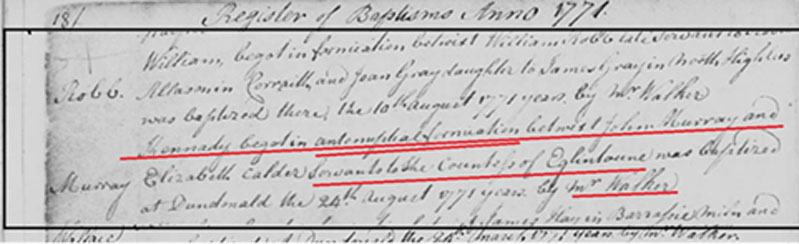
Copy of the original 24 Aug 1771 baptism record for Kennedy Murray, Old Parish Registers – 590/10144 Dundonald, National Records of Scotland.
And further research confirmed that Scottish Presbyterians in the 18th Century generally tolerated marriages involving a pregnant bride. However, the ‘sin of antenuptial fornication’ needed to be recorded on baptism certificates with both parents being also then required to front a local Presbytery session. This was to basically ‘apologise for their mistake’ before being accepted back into the fold. [The famous Scottish national poet Rabbie Burns (who grew up and lived nearby in Ayrshire around the same time) underwent more than one such Presbytery hearing in his eventful life]. In the Dundonald Kirk Sessions 1731-1781 (p.251) was the following entry for 25 Aug 1771: “this day John Murray servant to the Countess of Eglington voluntarily appeared before the session and acknowledged himself guilty of antenuptial fornication with Elizabeth Calder now his wife… the session appointed him to appear before the congregation in the forenoon to be rebuked and absolved’.
The story behind the name ‘Kennedy Murray’
The baptism certificate indicated that both parents were part of the Auchans Castle household in Dundonald of Lady Susanna, the Countess of Eglington – one of the most well-known and admired women in 18th Century Scotland. The famous author of the first English dictionary Samuel Johnson, who famously visited Susanna at her Auchans Castle in 1773 with his collaborator and biographer James Boswell, was also a great fan. As Boswell recalled of the visit in his Johnson biography: “Her figure is majestic, her manner high-bred, her reading extensive and her conversation elegant. She has been the admiration of the gay circles of life”. Not just this but our research indicates that because of her very close connection to the local Reverend Thomas Walker, Lady Susanna was able to organize for an early wedding between John and Elizabeth in a neighbouring parish (facilitated there by a Reverend Charles Ballantyne – a close associate of Walkers). She and Walker were also able to organise the sympathetic ‘antenuptial fornication’ Presbytery session held in August. The main reason for assisting the couple perhaps had to do with neither John Murray nor Elizabeth Calder were ‘just any servants’ in Susanna’s Auchans.
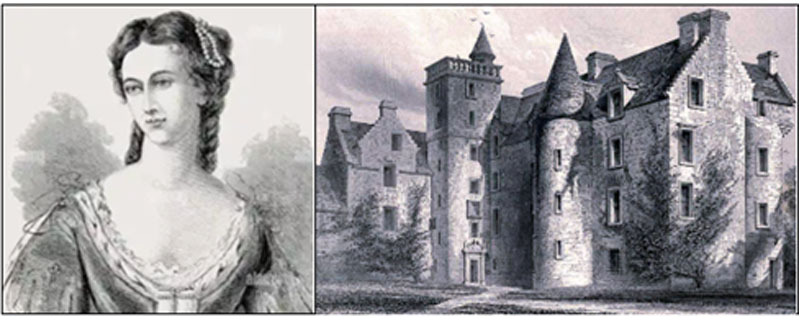
L. a surviving portrait of Countess of Eglington Lady Susanna. R. Auchans Castle
Elizabeth Calder (whose mother Elizabeth Kennedy was one of the Ayrshire Kennedys from Irvine) was it seems a reasonably close cousin of Lady Susanna. ‘Susanna’ was the favoured daughter of Sir Archibald Kennedy, the first Baronet of Culzean (and a chief of Clan Kennedy) before she became the second wife of the similarly prominent 9th Earl of Eglinton, Alexander Montgomerie, from nearby Kilwinning Castle. Likewise, John Murray was part of a family that had been mainly based in the Kilwinning village ‘serving’ the Earls of Eglington (and the Eglington’s Kilwinning castle and estate) since the early 17th Century – a family and village whose real business at Kilwinning (as distinct from the family’s other estates and ‘investments’) was the Kilwinning ‘mother lodge’ of Scottish (and modern) freemasonry. This is believed to have developed out of the last surviving Knights Templar lodge located in Kilwinning that was ‘authorised personally’ (as was the Montgomery and Seton families aka the Eglingtons) by King Robert the Bruce in the early 14th Century]. Susanna’s son Alexander was not just a onetime grandmaster of Scottish freemasonry (a role regularly held by the Kilwinning Montgomerys/Eglingtons), but it seems also the influential secret head of the then Jacobite-influenced European freemasonry movement. He was known within its inner circles as the mysterious and legendary ‘Knight of the Red Feather’
The further search for Kennedy Murray Sr’s Ayrshire ancestry
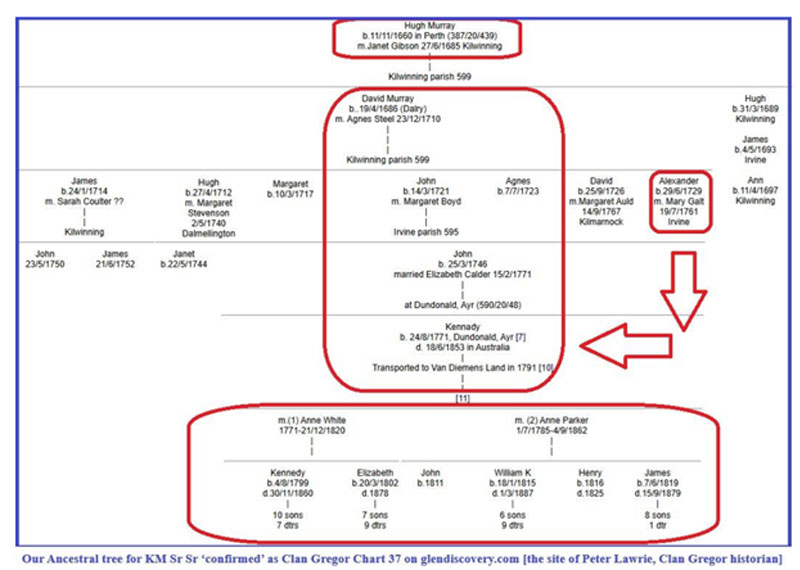
The related ‘clusters approach’ adopted helped frame a successful search back beyond the John Murray ‘dead-end’ experienced by some previous Kennedy Murray family history researchers. More flexible and adaptive strategies were needed to navigate the regular gaps in births, deaths and marriages (and also ‘misspellings’ and possible typographic errors) typical of rural Scotland especially in 18th Century and even more so in the 17th Century. This era was when many Scottish parishes first began to keep regular records. Any promising leads found would need to be cross-referenced to verify a consistent male line of descent for Kennedy Murray’s ancestors. In this way we were able to ultimately provide convincing verification of the links back beyond Kennedy’s father ‘John Murray Jr’. We subsequently found the birth records of a John Murray born 25 March 1746 in Irvine [SPR595-1021] to a John Murray [Sr] of the same name married to a Margaret Boyd. Other cross-referencing reasonably confirmed that the father was the same John Murray born 14 March 1721 in nearby Kilwinning [SPR599-10246] to David Murray and Agnes Steele.
We were also able to reasonably verify also (especially in terms of how these were the only Murrays in the vicinity at that time) how David was baptised 19 April 1686 at nearby Dalry [SPR587-109] to a Hough (Hugh) Murray married on 27 June 1685 to a Janet Gibson. It seems that Hugh (one of the first Murrays on record in that part of Ayrshire) and his wife Janet had two other sons in the 1680s – a Hugh (Jr) born 31 March 1689 (baptised Kilwinning – SPR599-1063) and James Murray (SPR595-1011) baptised in Irvine on 4/5/1693. It also seems that Hugh was mainly based in Kilwinning but was temporarily resident in nearby Dalry when David was born in April 1686 and likewise in Irvine when James was born there in May 1693. A daughter Ann was born in Kilwinning on 11 April 1697.
Also possibly contributing to this related cluster was a John Murray who had married an Isabel Boulton at Kilwinning on 29 Nov 1681 [SPR 599-10316]. This John was a general contemporary of Hugh (both would have been born about the 1650s). The available records were insufficient to clarify a direct family connection as related cousins also from Perthshire. However, we have been able to confirm an initial speculation about this was not correct. This is that both may have been directly related to the mysterious 12th Chief of Clan Gregor ‘John Murray’ who along with his wife and their children had disappeared from Edinburgh in the 1630s. This was not long after an additional 1633 Proscriptive ruling against the MacGregors (i.e. the ‘outlawing’ of Clan Gregor) of the main Act first enacted by King James VI in 1604. The 12th chief was the son of Ian MacGregor killed at Glen Fruin (and nephew of his brother Alasdair the 11th Chief executed by the King in 1604). He had taken the name of his mother who was from the ‘Tullibardine Murrays’ (who were later the ‘Atholl Murrays’) protected by that family – as had his brother ‘Patrick Murray’ who became the 13th Chief of Clan Gregor after the disappearance of his brother. Patrick had married a Campbell and apparently had their protection as long as he stayed out of politics and did not aid the re-emergence of the MacGregors.
This whole exercise had involved us needing to appreciate how varied the spelling of names was in the 17th Century rural Scottish records – another obstacle to negotiate with searches. Just as Hugh (Murray) was also spelt Hew and Hough as his wife Janet (Gibson) was also spelt Jannet and Jonet on the different records of their children. In this way we also discovered an apparently related cluster of ‘cousins’ who came to the area before Hugh. They were descended from a John Murray who was initially in Kilmarnock before later also moving to Kilwinning. In the first record we could find of him John was referred to as ‘Johne Morray’ in the registered baptism of his son 12 March 1657 [Kilmarnock 597-1065]). We know this Johne Morray is the one and the same John Murray, father of also Janet baptised 28 April 1667 [Kilmarnock 597-10104]. This is because it’s the same wife and mother with slightly different spelling also – Annabelle Wilsoun aka Anable Willsone. They had another son Robert baptised 30 Dec 1658 [Kilmarnock 597-1074]. This Robert married Elizabeth Kirkward 19 Nov 1693 [Kilwinning 599-10336]. So, whilst all three sons and a daughter were born in Kilmarnock (which is only 6 kilometres or so from Dundonald and slightly further to Irvine and Kilwinning) they all seemed to have generally ended up at Kilwinning at some stage or another later on (with some from this cluster later returning to Kilmarnock).
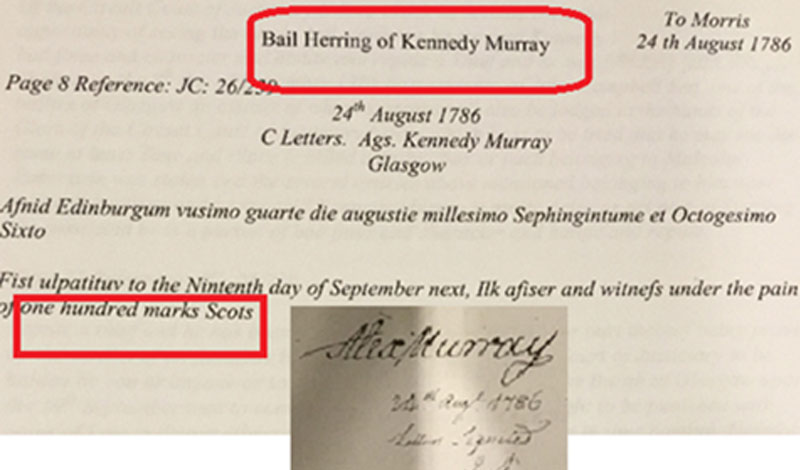
The Alex Murray who came to the Glasgow Tolbooth and assisted Kennedy Murray
In May 2020 we shared with family and friends a ‘discussion paper’ “From ‘King to convict’ and back again? Australian origins, the Murray mystery, and the re-emerging MacGregor legacy”. In June 2020 we also shared this with Peter Lawrie and Neil McGregor. In this paper we noted that we had found a ‘clinching’ cross-reference which seemed to confirm (and later was) our provisional ancestral tree for Kennedy Murray Sr back in time in 17th Century Ayrshire Scotland. This came whilst we were following up on a related KM mystery. We have documentary evidence that when a 14-year-old Kennedy Murray was facing charges in 1786 Glasgow (i.e. that the family feared may have resulted in him being convicted to hang because of a second minor offence), a relative who signed his name as Alex Murray came to assist (see ch.13). Alex Murray not only posted an expensive bail for Kennedy. He also paid for a solicitor at the time to write a Petition on Kennedy’s behalf to have him voluntarily ‘banished’ as a convict to the colonies rather than face a trial.