[this was a Jan 2025 post to the ‘Tasmanian Victoria Cross Descendants and Comrades FB group’ – run by Kerri Statton who attended as an invited guest our Kennedy Murray descendants gathering in Evandale in early 2024
My great-uncle Harry Murray VC from Evandale features quite significantly in my book out on Wednesday “Prosperous: The Kennedy Murrays and the origins of historic Evandale in early Colonial Australia” . Writing this helped me appreciate that he and his cousin Charles Murray Littler (aka ‘the Duke of Anzac’ – the last Australian soldier to leave Gallipoli beach) were really chips off the old block of their grandfather Kennedy Murray. When we had a small gathering in Evandale earlier this year, I was pleased that Kerri (also a friend of close cousin Sue Hill) was able to come and join us to visit surviving Evandale landmarks of Harry as well as his grandfather.
As I know this group might be interested in some of the relevant sections that focus on Harry, I have included below a few relevant excerpts from the book. Anyone interested in the book (a great tale of a Tasmanian ‘golden age’) can find out more at my site cameronkrichards.net/kennedymurrays.
Excerpts Chapter 1
- Introduction: How the unveiling of the Harry Murray VC statue in 2006 opened the door to remember the largely forgotten role of the Kennedy Murrays in the early history of Evandale
I am sure that the position could not have been held and our efforts crowned by victory but for the wonderful work of this Officer. His Company beat off one counter attack after another, three big attacks in all, although one of these consisted of no less than five separate bombing attacks… On one occasion the men gave ground for 20 yards but Captain Murray rushed to the front and rallied them by sheer valour, with his revolver in one hand and a bomb in the other. He was ubiquitous, cheering his men, heading bombing parties, leading bayonet charges or carrying wounded from the dangerously shelled areas, with unequalled bravery. So great was his power of inspiration, so great was his example that not a single man in his Company reported himself shell shocked although the shelling was frightful and the trench at times was a shambles that beggars description. His Company would follow him anywhere and die for him to a man… – Excerpt from Harry Murray’s VC recommendation in 1917 for his efforts in the Battle of Stormy Trench (https://www.awm.gov.au/collection/P11026799)
The link between the Harry Murray VC statue ceremony in Evandale in 2006 and the related unveiling that week of a memorial to ‘the Kennedy Murrays’
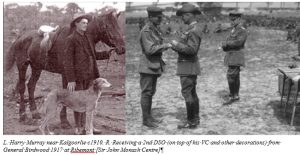
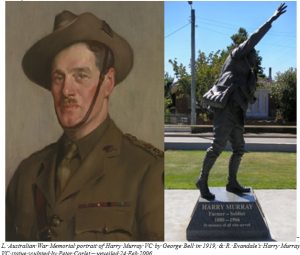
On 24 February 2006 there was a memorable and well attended statue unveiling ceremony held in Evandale which was officiated by Australia’s Governor General Michael Jeffrey. The statue was of Evandale-born Henry William Murray (aka ‘Harry Murray VC’) who remains the most decorated soldier in Australian history (and was the most decorated soldier in the British Empire in WW1 or ever). Charles Bean, the Official War Correspondent noted for his early and consistent articulation of the Australian ‘Anzac’ spirit and legend, regularly referred to Harry Murray in his reports and histories of WW1. “Australia’s most significant fighting officer” was Bean’s designation for the man who began the war as a mere private and was literally promoted to Colonel on WW1 battlefields from Gallipoli up to and across the Western Front. Harry received the VC for valour at Stormy Trench in 1917 – and his other military awards included the CMG, DSO and bar, DCM and Croix de Guerre. His almost forgotten story (and, following Tasmanian efforts, also his Australia War Memorial portrait) [1] has been resurrected in a timely and celebrated fashion before and after the 2006 statue unveiling. Such books as Frankl & Slatyer’s Mad Harry: Australia’s Most Decorated Soldier (2003) and Hatwell’s No Ordinary Determination: Percy Black and Harry Murray of the First AIF (2005) as well as a growing number of related military journal and online articles (Cf. also the Australian War Memorial tribute online at https://www.awm.gov.au/collection/P11026799) have assisted with this.
This occasion was also the focus for the meeting of many descendants of not only Harry’s grandfather Kennedy Murray (KM Jr) but his great grandfather Kennedy Murray Senior (KM Sr). KM Sr came to Australia in 1792 with the Fourth Fleet, and lived a long and colourful life (dying in Evandale in 1853) to become the head of one of Australia’s bigger family trees (see the chapters of Part 2). The media focus of this occasion was on the Harry Murray VC statue unveiled in what is now known as Evandale’s Harry Murray War Memorial Garden. This garden is significantly just up the road a few hundred metres away from Kennedy Murray’s still existing ‘Georgian Manor’ Prosperous House (the original cottage built in 1820 and the later ‘mansion’ version in 1836) – later re-named Fallgrove House. It’s directly opposite to the also still existing Briar Lane Cottage of Murray’s brother-in law George Collins which was likewise built in the 1820s and later extended. This was the initial ‘adjoining ‘hamlets’ blueprint for how the extended Murray family played a central role in the early formation of Evandale in various ways that have also largely become forgotten.
However, just a few hundred metres away in the other direction along Evandale’s Murray Street there escendants who were also in Evandale for the Harry Murray statue unveiling. This took place in the original Anglican cemetery on the very spot of the first Murray family vault where KM Sr and KM Jr’s first wife Sarah were also buried. [As will be explained later, KM Jr and his second wife Hannah were buried in the ‘other family vault’ which still exists in the Scottish Presbyterian (now Uniting Church) cemetery literally across the road]. Organised by family historians Joseph Cocker and Terry Browne, this was the ‘unveiling’ rather of a plaque remembering as ‘early pioneers of Australia’ the Kennedy Murray father and son who both died in Evandale some years before Harry was born there in 1880.
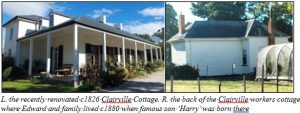
As indicated above, we are reasonably sure that as per agreements reached by Hannah Goodall Murray with both David Murray and neighbour John Pearson in the early 1860s, Edward Kennedy Murray and his growing family with Clarissa Littler remained resident in Woodstock cottage whilst leasing and farming part of the former Blanchfield farm of his father. This arrangement seems to have lasted until 1881 when Edward Kennedy Murray was able to lease the Northcote farm at St Leonards. This was where his youngest daughter Annie Summers Murray (named after Clarissa’s mother) was born in 1883 and where he then remained until his death in 1904. However, EKM and family spent a year or so in between (c1880) living in the workers cottage behind the former Clairville House of John Sinclair. At this time Clairville was owned by the same Cameron family who had originally arrived on the same ship as the McLeods in 1824 and then acquired the large Forden farmland on the Nile Rivulet adjacent to Samuel Bryan’s Strathmore and James Cox’s Clarendon. It was in this cottage (just up the road from Hannah Goodall Murray’s new Trafalgar farm) that EKM’s son Henry William Murray (aka Harry Murray) was born on 1 Dec 1880. The arrangement appears part of some related temporary employment deal between EKM and the Camerons as he organised the move to Northcote [2].
Chapter 10 excerpt 2.
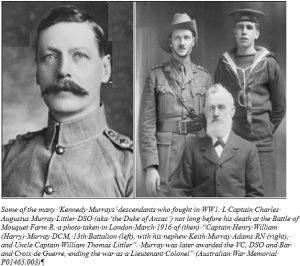
10.2 Kennedy Murray’s ‘Anzac grandsons’ at the WW1 Battle of Mouquet Farm
The Battle of Mouquet Farm was part of the infamous Somme offensive of 1916 on the Western Front. Almost 20,000 British soldiers died the first day of ‘Somme’ in futile trench warfare involving mainly suicidal attacks on defended machine-gun nests ordered by distant senior officers. Close to a million men from both sides were either killed or wounded by the end of this ‘offensive’. The month-long ‘battle of Mouquet Farm’ had particular significance for many soldiers in the AIF – which suffered over 11000 casualties there (and over 23000 if you include the linked battle of Pozieres). His cousin (the then Captain Harry Murray) and his own son Geoff had both been wounded and evacuated days earlier before the fateful last attack by the Australians involving Captain Charles Augustus Littler on the dawn of September 3. On that day Littler ignored both illness and leave given to him to visit his son before leading his company on yet another attack on a German machine gun nest from ‘the trenches’.
Having got to know Littler (as well as Murray) well at Gallipoli (calling him ’the “best known personality on Anzac Beach”), the Australian war historian Charles Bean had met with him the night before and later wrote of Littler’s brave death whilst continuing to inspire his men even after being badly wounded. Likewise, within minutes of his own shrapnel injuries on August 29 from a bomb blast (which saw him evacuated to a hospital in England to heal before returning to the battlefield yet again months later), an isolated as well as injured Harry Murray (on one of his regular ‘officer-lead recces’ into no-man’s land) had found himself alone surrounded by five German soldiers. Undaunted, he killed two with his service revolver before the others ran off. A machine gun or bomb blast death was really the ‘luck of the draw’. Murray received his first of two Distinguished Service Order decorations for his efforts at ‘Mouquet Farm’.
Like many other Anzac officers, Murray and Littler both strongly believed in inspiring their troops by leading from the front with hope and determination whatever the situation – as well as protecting the interests and welfare of their men whenever possible. Out of the grandchildren from KM’s second family with Hannah Goodall, then, there was not just one ‘famous Anzac hero” in WW1 but at least two. [Just one could have been perhaps dismissed as just a ‘lucky accident’, but two starts to suggest something more]. Of course, these two men just reflected the courage and Anzac ethos of so many Australian soldiers in WW1 (including Littler’s other younger son Guy who months earlier had been promoted to Lieutenant ‘on the battlefield’ before also being seriously injured demonstrating valour that saw him being awarded the Military Cross medal for bravery).
As well as Charles Bean’s related comments about Harry Murray (such as that Murray was “Australia’s most distinguished fighting officer” in WW1) particularly relevant here is that he was “one who always rose to the occasion, practical and careful, yet at the same time reckless of personal safety … one who always got the best out of their men”. Bean also made a very similar comment about Charles Littler in his war diaries (“a brave, honourable and experienced leader, the whole battalion looked up to him as to no other”).
Bean’s seminal articulation of the ‘Anzac legend’ on the Western Front as well as earlier at Gallipoli reflected on the unique (native-born) Australian values of ‘courage, egalitarianism, endurance, mateship, initiative and a basic optimism whatever the situation’. For Bean such traits generally distinguished the Anzacs from European soldiers too often debilitated by the passivity regularly borne of ‘old class divisions’ – especially involving those officers who too often thought they were superior and entitled to stay at the rear when ordering men to their deaths in WW1 trench warfare. When making his related comparison between Australians and the officers of other armies, Bean seems to have been particularly inspired to make this distinction by the examples of cousins Captain (later Colonel) Murray and Captain Littler both regularly leading with inspiration from the front. As Bean recognised, these were men who also exemplified the related ‘bush ethos’ derived from the rural Australian communities inspired by such early native-born Australian pioneers as Kennedy Murray Jr (who, as evident also in early Evandale, the more superior or entitled UK migrants and ‘bunyip aristocrats’ tended to look down upon, under-estimate and often attempted to exploit or betray).
Excerpt chapter 14
- Evandale as ‘home’ for not just ‘local son’ Harry Murray VC but all the
Kennedy Murrays (one of modern Australia’s larger family trees)
On a post-World War II visit to Launceston, his nephew Joseph Murray Cocker, son of his [Harry’s] favourite sister Annie (Dot) Cocker, suggested to Harry Murray that he pay a visit to the grave of his father in Evandale. Murray refused, saying “No, I haven’t got any time for him. I have nothing to thank him for”. Cocker was surprised at his uncle’s vehemence. A few days later, however, Murray proposed to his nephew that they make a visit to the Launceston airport, and on arrival he instructed Cocker to go further to the Scot’s Kirk in nearby Evandale. He then left the car and walked straight over to his father’s grave [also part of the KM Jr second family crypt] which was overgrown with blackberries. Soon thereafter, Harry Murray approached the authorities and paid to have the grave permanently maintained.
– G.Frankl & C.Slatyer (2003), Mad Harry: Australia’s most decorated soldier, p 5-6.
Except chapter 15
- The astonishing further story of the recent discovery that KM Sr’s ‘Ayrshire Murrays’ ancestral tree is one of post-1603 ‘hidden MacGregors’ (i.e. the Glenlyon branch of the ‘royal is our blood’ Scottish Clan tradition)
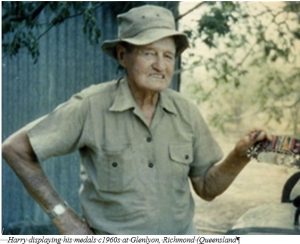
It was the biggest public investiture since the first presentation of VCs, again at Hyde Park by Queen Victoria on 16 June 1857. Murray was the most prominent recipient of decorations at the [1917] investiture, for in addition to his Victoria Cross he received his two DSOs to join his earlier awarded DCM. King George V spoke to Murray for some time (p.113)… It was perhaps on this his first trip to Scotland that he stayed at Glenlyon in Perthshire at the home of Lord and Lady Montgomery. Murray became attached to the Montgomerys and, his family believes, had a romance with Clementine, a daughter of the house who became a lifelong friend and after whom he named his daughter. By coincidence the property outside Richmond Queensland on which he finally settled in 1928, was named Glenlyon (p.114)… [Harry Murray’s family] stressed that he was intensely proud of his Scottish Highlander ancestry, as he believed it to be. He was imbued with the traditional Scottish virtues of courage, endurance and loyalty, and no doubt modelled his behaviour on them (p.184).
– G. Frankl & C. Slatyer (2003), Mad Harry: Australia’s most decorated soldier.
Postscript: Harry (MacGregor) Murray’s 1917 Glen Lyon ‘homecoming’?
After the June 1917 Hyde Park Investiture where he was awarded his VC as well as his two DSOs by King George V, Harry Murray had become a minor celebrity and feted in the UK Press. This was apparently even more so in Scotland because of his family name. Soon after this he was invited by the Duke of Atholl to visit Blair Castle to discuss possible Murray related family connections. He was soon guest of honour there at a related function in the Blair Castle ballrooms. On the same visit it seems, he had received another invitation to visit the Montgomerys of Glenlyon. And as per the quote at the beginning of this chapter, he developed a particular connection to Clementine Montgomery and apparently made further visits there. This was before his return to Australia in 1919 a full twelve months after the WW1 armistice. He had been given special leave by the AIF to go off and ‘study UK farming methods’ (including in Scotland) for some months before then.
It was some years later that he bought a large sheep station named Glenlyon at Richmond, Queensland. It was here that he lived from 1928 until his death at 86 in 1966 after a car accident (the ‘farm’ remained in the family for about another 40 years). No doubt he was likely attracted to buy the property in part because of his memories of visiting the original Glen Lyon area in Perthshire some years earlier. Like his great grandfather Kennedy Murray Sr, he was not sure about his original Scottish ancestry except for one thing. This was that he passionately believed he was descended from Scottish highland peoples (and no doubt felt very much at home on those Glen Lyon visits).
I still have very vivid memories as a young boy of Harry loudly and confidently holding court at the Glenlyon family ‘Christmas dinner’ in 1965 just months before his death. I have no doubt that he would have been particularly chuffed at our ‘coincidental discovery’ that Glen Lyon was an ancestral home of sorts after all. He would have been proud to be linked also to the particular Scottish highland clan which, with its heroic warrior traditions, perhaps best exemplified ‘the traditional Scottish virtues of courage, endurance, and loyalty [that he]… no doubt modelled his behaviour on’. So it was that in 2023, as part of related research for this book (along with that of my mother’s separate line of ‘Murray ancestors’) I also went to Glen Lyon to follow in the footsteps of Harry Murray as well as the family of Sir James MacGregor, Dean of Lismore.
[1] In recent decades the Australian War Memorial had taken Harry’s portrait (see above) down from its display halls. Coincidentally perhaps, this was after Harry’s children Doug and Clem had declined various offers to either sell to others or to donate to the Memorial his VC and other medals. Soon after the statue unveiling (thanks to efforts of the then Senator Guy Barnett and others at the time) the Portrait was ‘re-installed’. In 2015 Clem came to an agreement with the Memorial to let them have an ongoing ‘loan’ of the medals.
[2] Clarissa Littler lived with daughter Annie Summers Murray (or ‘Dot’ as she was known in the family) and her husband David Cocker in Launceston after the death of EKM in 1904 up until her own passing in 1933. This was one of the reasons that Harry Murray remained particularly close to both his sister Dot and her elder sister Hannah Goodall (obviously named after her mother) – who like Dot had married a Cocker brother (with Hannah marrying Joshua Reynolds Cocker). Consequently, Dot’s son Joseph Murray [Joe] Cocker and Hannah Jr’s grandson Peter Cocker both retained a local proximity to their particular interests in the Murray family history and genealogy [Cameron Richards’ additional personal note: I am likewise a great grandson of Hannah Jr (and Joshua Reynolds Cocker) – as well as being a 2 X great grandson of both Kennedy Murray and Hannah Goodall]
[3] We mentioned earlier that our investigation into the Kennedy Murray ancestry was initially linked to a related personal inquiry into our separate ‘maternal Murray ancestry’. We eventually found lost records of this Murray lineage back in time in Scotland. They were also not ‘Atholl Murrays’ nor linked to the Kennedy Murrays. However, we found that my mother’s different Murray forebears derived in particular from Maryculter (and surrounding towns also) along the Dee River outside Aberdeen. Further research has revealed the area was a known ‘Pictish Celt’ stronghold long ago. This Murray (or Morays) lineage may have gone back further than the original 1225 CE buildings of the nearby Maryculter House (at that time a Knights Templar ‘college’ on land granted to yet another Norman family in 1187 CE).
4] There are related Australian Dictionary of Biography as well as Wikipedia entries for Charles Augustus Murray Littler who was born 1868 and was 48 years old when he died. He had lived an adventurous and interesting life also before WW1. From his home in Devonport (where his wife and children remained), he was based for many years in the Philippines. It is here he ran a business whilst serving as a commercial agent for the Tasmanian government in the Far East – regularly getting caught up in various escapades (including intelligence work for the British navy and American forces as well as serving as a supply officer for three Russian cruisers for five months). A fuller account of his life can be found in the 1991 Canberra Times article The adventures of the Duke of Anzac [] https://trove.nla.gov.au/newspaper/article/122400528